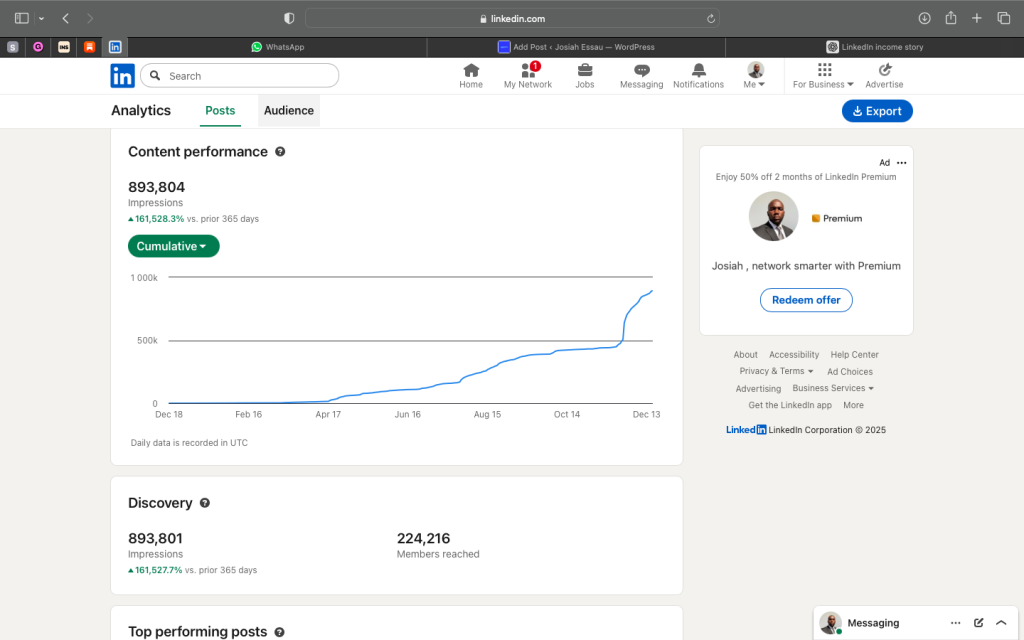
Let me start with the uncomfortable truth:
I didn’t make $5,000 on LinkedIn because I’m special.
I made it because most people are using LinkedIn wrong.
This is not a motivational post.
This is not a “wake up at 5am” story.
This is not a fake thread that ends with “DM me ‘GROWTH’”.
This is a full, honest breakdown of how I used LinkedIn to generate real money, as a professional from Tanzania, without paid ads, without a large team, and without pretending to be a Silicon Valley guru.
If you’re serious, read slowly.
If you want shortcuts, stop here.
1. Why LinkedIn (and Not Instagram, TikTok, or Twitter)
Before we talk money, we must talk environment.
LinkedIn is not a social media platform.
It is a marketplace disguised as a feed.
- People come with money
- People come with problems
- People come with authority
- People come with budgets
Instagram has attention.
TikTok has reach.
Twitter has noise.
LinkedIn has decision-makers who can pay without begging for discounts.
That alone changes everything.
2. The First Mistake Everyone Makes on LinkedIn
Most people treat LinkedIn like:
- A CV
- A diary
- A motivational poster board
I treated it like:
A digital shop window for my thinking
Not my certificates.
Not my GPA.
Not my job title.
My thinking.
People don’t pay for resumes.
They pay for clarity.
3. I Didn’t Sell Services First. I Sold Perspective.
Here is where most people fail.
They jump straight to:
“I offer consulting.”
“I do strategy.”
“Hire me.”
Nobody cares.
I did the opposite.
I posted about:
- Broken systems
- Bad policies
- Power dynamics
- Institutional failures
- Real-life consequences of decisions made by “adults in suits”
I explained complex things in simple language.
Slowly, people started saying:
- “This makes sense”
- “I’ve never thought of it this way”
- “Can you explain this to my team?”
That’s when money starts smelling you.
4. My Headline Was Not Polite (And That Helped)
My headline wasn’t safe.
It didn’t say:
“Political Scientist | Consultant | Researcher”
It said something closer to:
“I babysit bad decisions made by adults in suits and try to explain them to normal people.”
That line:
- Confused people
- Annoyed some
- Attracted the right ones
Clarity repels the wrong audience.
You don’t want everyone.
You want buyers.
5. Content Strategy: What I Actually Posted
Let’s be specific.
I didn’t post every day.
I didn’t chase trends.
I didn’t copy templates.
I rotated between five content types:
1. System Explainers
Posts that broke down:
- Policies
- Government decisions
- Economic logic
- Institutional behavior
Written like I’m talking to a smart friend, not an academic journal.
2. Opinion With Evidence
Not hot takes.
Cold analysis with warm language.
People trust confidence backed by reasoning.
3. Professional Vulnerability
Not trauma dumping.
Not fake humility.
Real experiences:
- Projects that failed
- Money lost
- Clients who disappointed
- Lessons learned
This builds human trust, not pity.
4. Observational Humor
LinkedIn humor that makes professionals say:
“This shouldn’t be funny… but it is.”
Humor disarms power.
5. Soft Invitations
Never:
“Buy my service”
Always:
“If this is useful, let’s talk.”
6. Where the $5,000 Actually Came From
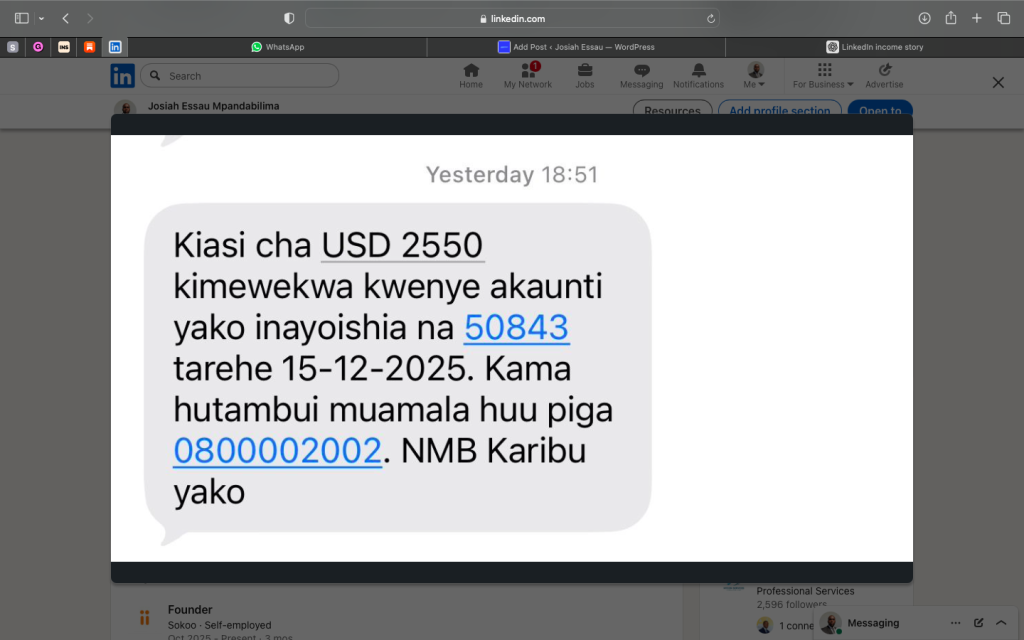
Let’s break the myth.
I did not make $5,000 from:
- Ads
- Courses
- Affiliate links
- Viral posts
The money came from conversations.
Here’s the rough breakdown (approximate):
- Advisory calls
- Consulting retainers
- Writing & analysis gigs
- Strategy sessions
- Referrals from people who read my posts quietly
No funnels.
No landing pages.
No sales scripts.
Just trust compounded over time.
7. The Inbox Is Where LinkedIn Pays You
The feed builds credibility.
The inbox builds income.
But here’s the rule:
Never pitch in the inbox.
People messaged me like:
- “Can we talk?”
- “I need your perspective”
- “We’re dealing with this issue…”
I responded like a human.
Not a salesperson.
Money came later.
8. Why Being in Tanzania Didn’t Stop Anything
Let me be clear:
Geography is no longer an excuse.
But positioning still matters.
I didn’t pretend to be global.
I leaned into local context + global logic.
That combination is rare.
People abroad don’t need another generic thinker.
They need someone who understands:
- Emerging markets
- Institutional complexity
- Political realities
- On-the-ground consequences
Your location is a lens, not a limitation.
9. What I Didn’t Do (And You Shouldn’t Either)
Let’s kill some fantasies.
I didn’t:
- Fake screenshots
- Rent luxury spaces
- Claim “7-figure clients”
- Use AI to sound smart
- Copy viral threads
LinkedIn punishes exaggeration slowly but permanently.
Reputation compounds.
So does bullshit.
10. The Silent Readers Matter More Than the Loud Ones
Here’s something nobody tells you:
The people who pay rarely like, comment, or repost.
They:
- Read quietly
- Watch consistency
- Wait
Then one day they message:
“I’ve been following you for a while…”
That sentence is money in disguise.
11. The Psychological Shift That Changed Everything
At some point, I stopped asking:
“What should I post?”
And started asking:
“What do people misunderstand that I can clarify?”
That shift:
- Removes pressure
- Creates authority
- Builds demand naturally
Experts teach.
Amateurs perform.
12. Why $5,000 Matters (And Why It Doesn’t)
Let’s be honest.
$5,000 is:
- Not life-changing money
- Not internet-flex money
- Not guru money
But it is:
- Proof
- Validation
- A signal
It tells me:
This works.
This can scale.
This is real.
And more importantly:
It was earned without losing my voice.
13. The Long Game Most People Are Too Impatient To Play
LinkedIn rewards:
- Consistency over virality
- Clarity over noise
- Substance over aesthetics
Most people quit after 30 days.
I stayed.
That’s the unfair advantage.
14. If You Want to Do This Too, Read This Carefully
LinkedIn will not pay you if:
- You’re vague
- You’re generic
- You’re scared to offend
- You sound like everyone else
It will pay you if:
- You think clearly
- You write honestly
- You respect the reader
- You’re patient enough to compound trust
15. Final Truth (No Motivation, Just Reality)
LinkedIn did not give me money.
People did.
LinkedIn simply made it visible.
And visibility, when paired with clarity, eventually turns into income.
If you’re serious about using LinkedIn to earn:
- Stop chasing hacks
- Stop copying styles
- Start sharpening your thinking
Money follows clarity.
Every time.
If you’re still reading this:
You’re not curious.
You’re ready.
And that’s exactly how this journey started for me too.